


Industrial Motor Installation in BC: A Comprehensive Guide to Standards and Precision
A motor that is wired to code but mechanically misaligned is not a finished job; it is a liability. When you are managing an industrial motor installation BC project, the stakes involve much more than just turning the power on. If the mechanical precision of the mounting does not match the electrical standards of the connection, you are essentially scheduling a future breakdown before the first shift even begins.
I understand the pressure of maintaining a tight production schedule while trying to find specialists who can handle both the millwright work and the complex electrical requirements. It is a common frustration to juggle multiple teams just to ensure compliance with Technical Safety BC and the 2024 Canadian Electrical Code. You deserve a setup that runs at peak efficiency from day one without the looming threat of premature bearing failure or regulatory fines.
In this guide, I will explain how to merge millwright precision with Red Seal electrical standards to protect your investment. You will learn the specific technical steps required to achieve a seamless installation that minimizes plant disruption and keeps your facility running at its full potential.
Key Takeaways
Learn how to navigate the 2024 Canadian Electrical Code and Technical Safety BC permit requirements to ensure your facility remains fully compliant.
Discover why an integrated approach to industrial motor installation BC, combining Red Seal electrical work with millwright precision, is the only way to guarantee long-term reliability.
Understand the critical role of laser alignment in preventing premature bearing failure and how to identify "soft foot" issues before they cause frame distortion.
Get a clear roadmap for the initial startup phase, including proper lubrication protocols and vibration testing to protect your equipment from day one.
Learn how a single-source service provider can minimize plant downtime and streamline complex installations across the province.
Table of Contents
BC Facility Standards for Industrial Motor Installation
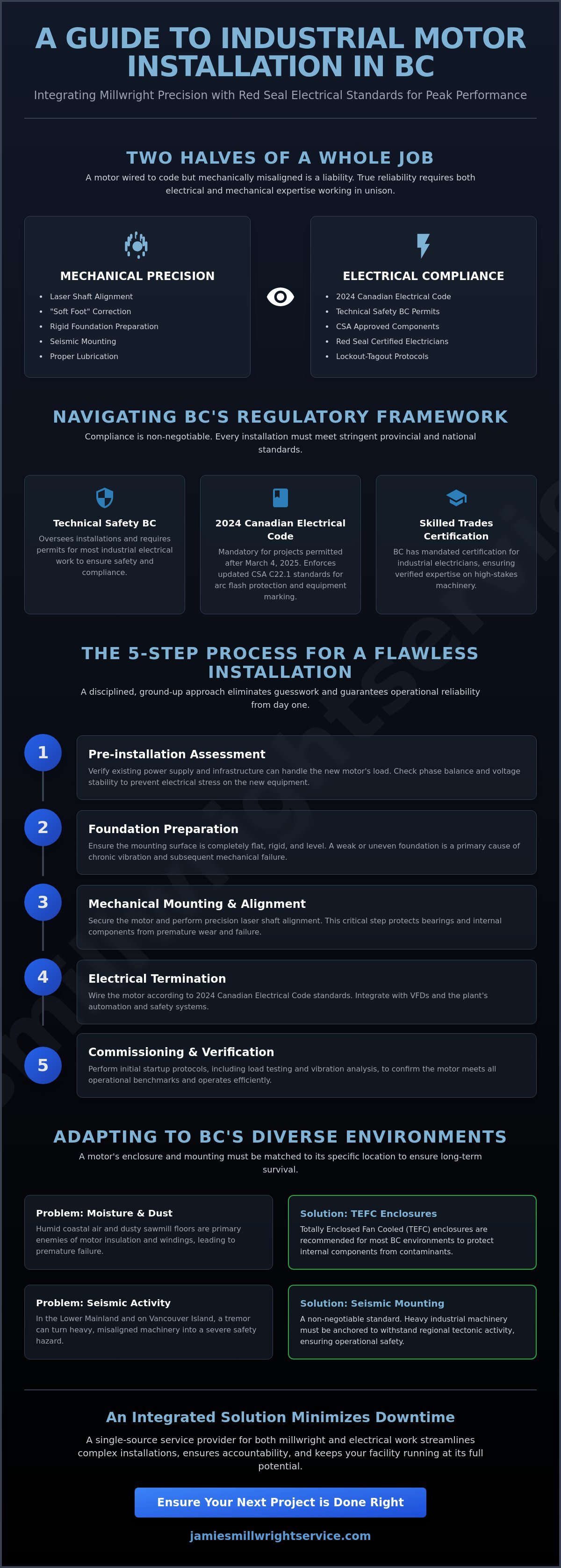
British Columbia operates under a specific regulatory framework that demands high accountability from facility managers and contractors alike. The adoption of the 2024 Canadian Electrical Code (26th edition) as the new BC Electrical Code marks a significant shift for industrial sites across the province. Effective March 4, 2025, any industrial motor installation BC project permitted after this date must comply with these updated safety standards. This includes mandatory marking of equipment with maximum load and enhanced arc flash protection measures to safeguard workers.
Technical Safety BC oversees these installations to ensure they meet the CSA C22.1 standards. When we handle high-voltage motor setups in sawmills or manufacturing plants, safety protocols like lockout-tagout and proper grounding aren't just suggestions; they're legal requirements. A standard Electric motor requires precise integration into the facility's existing infrastructure to maintain operational stability. Following these provincial guidelines ensures your industrial motor installation BC project is both safe and efficient from the moment the power is switched on.
Regulatory Compliance and Permitting
Determining if you need a permit is the first step in any motor upgrade. Technical Safety BC requires an installation permit for most industrial electrical work, especially when changing the load or circuit characteristics of a system. All components, from the motor itself to the Variable Frequency Drive (VFD) and disconnects, must carry a Canadian Standards Association (CSA) approval mark. I've seen many projects delayed because a contractor used non-approved equipment sourced from outside Canada. It's also vital to verify that your contractors hold the necessary Skilled Trades Certification. In BC, the government has phased in mandatory certification for industrial electricians to ensure that those working on your high-stakes machinery have the verified expertise to do the job right.
Environmental Considerations in British Columbia
BC's diverse geography means a motor in Prince George faces different challenges than one in Langley. For humid coastal environments or dusty sawmill floors, I typically recommend Totally Enclosed Fan Cooled (TEFC) enclosures over Open Drip Proof (ODP) models. Dust and moisture are the primary enemies of motor insulation. Additionally, temperature fluctuations can impact how a motor sheds heat, potentially leading to premature winding failure if the cooling system isn't sized for local extremes. In the Lower Mainland and Vancouver Island, seismic mounting is a non-negotiable standard. Heavy industrial machinery must be anchored to withstand regional tectonic activity, ensuring that a tremor doesn't turn a precision-aligned motor into a safety hazard.
The 5-Step Process for a Successful Industrial Motor Setup
A reliable industrial motor installation BC requires a disciplined sequence of events. It is not enough to simply bolt a unit to the floor and connect the leads. I follow a methodical five-step process to ensure every motor operates at its full potential from the first start. This system eliminates the guesswork that often leads to premature failure or safety violations. The process moves from the ground up, starting with a thorough site assessment and ending with precision vibration analysis.
Step 1: Pre-installation Assessment. I verify that the existing power supply and infrastructure can handle the new motor's load. This includes checking phase balance and voltage stability to prevent electrical stress.
Step 2: Foundation Preparation. The mounting surface must be rigid and level. A weak foundation is the primary cause of chronic vibration issues.
Step 3: Mechanical Mounting. We secure the motor and perform the initial shaft alignment to protect the internal components.
Step 4: Electrical Termination. This involves wiring the motor to the 2024 Canadian Electrical Code standards and integrating it with the plant's automation system.
Step 5: Commissioning. We perform load testing and vibration analysis to confirm the motor meets all operational benchmarks.
Phase 1: Foundation and Mechanical Mounting
Precision begins at the base. Before the motor ever touches the floor, I ensure the mounting surface is completely flat. If a motor is bolted to an uneven surface, it suffers from a condition known as "soft foot." This puts a physical twist on the motor frame, which can distort the stator and lead to internal rubbing. We use high-grade shims and precise torque specifications for every anchor bolt to prevent this. A stable baseplate is the only way to ensure the motor does not shift during high-torque starts. If you need assistance with these mechanical requirements, our Millwright Service provides the specialized tools and expertise to handle heavy-duty mounting projects.
Phase 2: Electrical Integration and Testing
Once the motor is mechanically secure, the focus shifts to the electrical connection. Large industrial motors require specific grounding techniques to prevent stray currents from damaging the bearings. I prioritize clean terminations and proper shielding, especially when the motor is controlled by a Variable Frequency Drive (VFD). Integrating the unit with your existing PLC and automation systems ensures the motor responds correctly to plant-wide commands. Before we couple the motor to the driven equipment, we always conduct a "bump test." This short burst of power verifies that the rotation direction is correct, preventing potential damage to pumps or gearboxes that are sensitive to reverse rotation.
Why Precision Alignment is as Critical as the Electrical Connection
Many contractors treat industrial motor installation BC as a strictly electrical task. If the wires are connected and the motor spins, they consider the job done. I take a different view. Mechanical alignment is the silent partner of electrical integrity. Without it, you are essentially trading a lower upfront cost for a guaranteed premature failure. Even a slight deviation in shaft position forces bearings to carry loads they weren't designed for, which quickly destroys the lubrication film and leads to catastrophic seizing.
Precision alignment is about more than just the initial setup. It involves accounting for thermal growth. A motor that is perfectly aligned when cold will shift as it reaches operating temperature. Metals expand under heat, and if your installer doesn't calculate this expansion, the alignment will fail once the plant is at full capacity. This friction doesn't just damage parts; it wastes money. With BC Hydro's industrial electricity rates set to increase by 3.75% in 2026, the energy wasted by a misaligned motor directly impacts your bottom line. Precision is a financial strategy as much as a mechanical one.
I prefer laser alignment over traditional dial indicators for most BC facilities. While dial indicators are a classic tool, they are prone to "bar sag" and human calculation errors over long spans. Laser systems provide real-time, digital feedback that allows for sub-thousandth of an inch accuracy. This level of detail ensures that the motor and the driven equipment operate as a single, harmonious unit.
The Millwright’s Role in Motor Longevity
A skilled millwright focuses on two primary types of misalignment: angular and parallel. Parallel misalignment occurs when the shaft centres are offset, while angular misalignment happens when the shafts are at an angle to each other. We use precision shims to correct these issues simultaneously. Beyond alignment, we also look at the balance of the entire system. If a heavy rotor is even slightly out of balance, the resulting centrifugal force creates rhythmic stress that can crack housings or vibrate mounting bolts loose over time.
Signs of Poor Mechanical Installation
You can often hear or feel a poor installation before it fails. Excessive heat near the bearing housings or a high-pitched whine are clear indicators of friction caused by misalignment. I recommend regular vibration analysis to catch these issues early. This process uses sensors to identify specific frequencies associated with misalignment or bearing wear. It allows us to schedule maintenance during planned downtime rather than reacting to a sudden, expensive mid-shift breakdown. Choosing the right coupling is also vital; a coupling that is too rigid will transfer stress directly to the motor, while one that is too flexible may fail under high-torque starts.
Preventing Premature Failure: Common Installation Pitfalls
Even with high-quality equipment, a flawed industrial motor installation BC can lead to expensive downtime. I've seen motors fail within weeks because simple checks were overlooked during the rush of a plant upgrade. One of the most insidious issues is "soft foot." While foundation prep is standard, failing to verify that all four feet sit flush before tightening leads to a warped frame. This distortion pulls the internal stator out of round, causing uneven magnetic pull and excessive heat that eventually cooks the windings.
Startup lubrication is another common failure point. Many new motors come with grease that may have settled or separated during storage. Mixing incompatible grease types can lead to a chemical reaction that hardens the lubricant, effectively starving the bearings. It's also vital to verify the PLC control logic before the motor is under full load. If the automation system doesn't ramp up the speed correctly or fails to recognize a fault signal, the motor can be pushed beyond its thermal limits within seconds. If you want to avoid these technical traps, our Electrical service team can ensure your power quality and mechanical setup meet the highest standards.
Electrical Pitfalls and Power Quality
You must verify the power quality at the motor terminals, not just the main breaker. A voltage unbalance of just 1% can lead to a significant increase in motor temperature, often exceeding the insulation rating. In many parts of BC, where power lines are exposed to heavy storms and falling timber, surge protection is a necessity for protecting VFDs and motor windings. I also check that wire gauges are sized correctly for the distance from the control centre. Undersized cables lead to voltage drops that force the motor to draw more current, which generates heat and reduces efficiency.
Mechanical Pitfalls: Vibration and Stress
Every industrial motor installation has a resonant frequency. If the motor's operating speed matches the natural vibration of the mounting structure, the resulting oscillations will destroy the unit. You must realize the importance of a clean, debris-free installation site; even a small piece of grit under a shim can cause alignment drift. In belt-driven systems, over-tensioning is a frequent error. It puts a massive overhung load on the motor bearing, leading to premature failure. Proper tensioning and a clean environment are simple steps that prevent complex, expensive repairs later.
Integrated Millwright and Electrical Solutions for BC Industry
The most successful industrial motor installation BC projects share a common trait: a unified approach to mechanical and electrical trades. When you hire separate contractors for the millwright work and the electrical wiring, you often create a gap in accountability. If a motor develops a vibration or an electrical fault, the trades may blame each other’s work rather than solving the problem. I eliminate this friction by providing an integrated solution where the precision of the mechanical alignment is perfectly synchronized with the electrical integration.
I take personal responsibility for the entire scope of the project through Jamie's Millwright Service Inc. This includes not only the installation but also any necessary custom fabrication. If a new motor doesn't fit a legacy baseplate, our Welding service allows us to modify or create custom mounts on-site. This capability keeps the project moving without waiting for third-party fabricators. By handling the welding, mechanical mounting, and electrical termination under one roof, I ensure that every component meets the high operational standards required by BC’s industrial sector.
Our Approach to Industrial Motor Projects
Precision is the foundation of my work, but it must be backed by technical intelligence. My approach combines millwright accuracy with expert PLC and Automation integration. It isn't enough for a motor to spin; it must communicate correctly with your plant's control systems. I verify that every sensor, drive, and control loop is calibrated to protect the motor from over-torque or phase-loss conditions. This methodical planning is how I minimize downtime. I realize that every hour your line is down represents lost revenue, so I organize each install to be as lean and efficient as possible.
Serving All Regions of British Columbia
BC industry isn't confined to the Lower Mainland. I provide mobile service capabilities that reach from the busy manufacturing hubs of Langley to the remote sawmills near Prince George. Whether you are operating a facility on Vancouver Island or a processing plant in the Interior, you deserve access to high-level technical expertise. My commitment is to provide quality results that keep your equipment running for its full lifecycle, regardless of your location. I understand the unique logistics of remote sites and come prepared with the tools and parts necessary to complete the job right the first time. If you are ready to ensure your next project is handled with the precision it requires, Contact Jamie's Millwright Service Inc for your next BC motor installation. I am ready to help you maintain a safe, efficient, and compliant facility.
Securing Your Facility’s Operational Future
A successful industrial motor installation BC requires a commitment to both regulatory compliance and mechanical precision. By following the 2024 Canadian Electrical Code and prioritizing laser alignment, you ensure your equipment runs efficiently for its entire lifecycle. It's about more than just a successful startup; it's about preventing the soft foot and vibration issues that lead to expensive mid-shift failures. When the mechanical mounting and electrical integration work in harmony, your facility gains a level of reliability that separate contractors simply cannot provide.
Since 2014, I've served the BC industry by providing Red Seal certified tradespeople who take personal accountability for every project. We combine this hands-on millwright experience with specialized PLC and automation expertise to handle even the most complex facility upgrades. If you're ready to modernize your operations with a team that values directness and integrity, I'm here to help. Get a Professional Quote for Industrial Motor Installation in BC and let's keep your production line moving with confidence.
Frequently Asked Questions
Do I need a permit for a motor replacement in BC?
Technical Safety BC typically requires an installation permit for new motor setups or significant equipment upgrades within a facility. While minor like-for-like maintenance might be covered under an annual operating permit, you should always verify the specific requirements for your site. Ensuring your industrial motor installation BC project is properly permitted prevents legal complications and ensures the work meets provincial safety standards.
What is the difference between an electrician and a millwright in motor installation?
An electrician is responsible for the power supply, control wiring, and grounding, while a millwright handles the physical mounting and precision shaft alignment. A successful industrial motor installation BC relies on both trades working together. If the electrical work is sound but the mechanical alignment is neglected, the motor will fail prematurely due to excessive stress on the bearings and internal components.
How often should I perform vibration analysis on a new motor?
I recommend an initial vibration analysis during the commissioning phase to establish a baseline, followed by a secondary check after the first 100 hours of operation. This secondary test is vital because it catches any settling or alignment shifts that occur as the machine reaches its standard operating temperature. Regular monitoring after this period helps you identify wear before it leads to an unplanned shutdown.
Can improper alignment affect my electricity bill?
Yes, shaft misalignment creates significant internal friction that forces the motor to draw more current to maintain its speed. This increased electrical demand leads to higher utility costs for your facility. By maintaining precision alignment, you ensure the motor operates at its peak efficiency, which helps control energy expenses in an environment of rising industrial power rates.
What is "soft foot" and why is it dangerous?
Soft foot is a condition where the motor's feet do not sit perfectly flat on the baseplate. When you tighten the anchor bolts on an uneven foot, the force physically warps the motor frame. This distortion pulls the internal stator out of alignment with the rotor, causing uneven magnetic pull and excessive heat that can destroy the motor windings and bearings.
Does Jamie's Millwright Service Inc provide emergency motor repairs in BC?
Yes, Jamie's Millwright Service Inc provides comprehensive emergency repair and maintenance services for industrial facilities across the province. I understand that mechanical failures don't follow a schedule, so I offer mobile support to address critical issues on-site. Whether you are dealing with a seized bearing or a complex automation fault, I am committed to getting your operations back online quickly and safely.


Comments